Hydrosila participated in the Bauma 2025 exhibition!
13.04.2025
Over the years, I have visited many impressive industrial enterprises. I have descended into uranium mines, touched the turbine of a hydroelectric power plant, toured shipyards and major steelworks, and even watched tanks being manufactured at the Malyshev Plant in Kharkiv. I thought there was little left that could surprise me. But a recent visit to one of our local factories proved otherwise.
There is a remarkable enterprise right here in Kropyvnytskyi — HYDROSILA APM. It is the kind of factory that would make an excellent destination for an industrial tour.
The company has just celebrated its tenth anniversary. In November 2009, the axial piston pump and motor division was separated from the main HYDROSILA plant and became an independent enterprise. The original plant continued manufacturing gear pumps, while HYDROSILA APM concentrated on axial piston hydraulic units. The restructuring was primarily intended to make production development more efficient.
For readers unfamiliar with hydraulics, a brief explanation may be helpful. Hydraulic pumps convert mechanical energy — the rotation of a shaft driven by an engine or motor — into hydraulic energy by generating a flow of pressurized fluid when the system offers resistance. Hydraulic systems make it possible to raise a dump truck body, operate an excavator bucket, drive a road roller and lift heavy loads with a crane.
Gear pumps are relatively simple in construction and considerably less expensive. Their displacement is generally fixed, whereas variable displacement axial piston pumps allow hydraulic flow to be controlled by changing the pump displacement. Axial piston pumps are more complex, but they also offer higher efficiency.
As the name suggests, axial piston machines use pistons. Their operation is somewhat reminiscent of the pistons in an internal combustion engine. However, there is no combustion process: the pistons transfer mechanical energy to the hydraulic fluid, usually mineral oil.
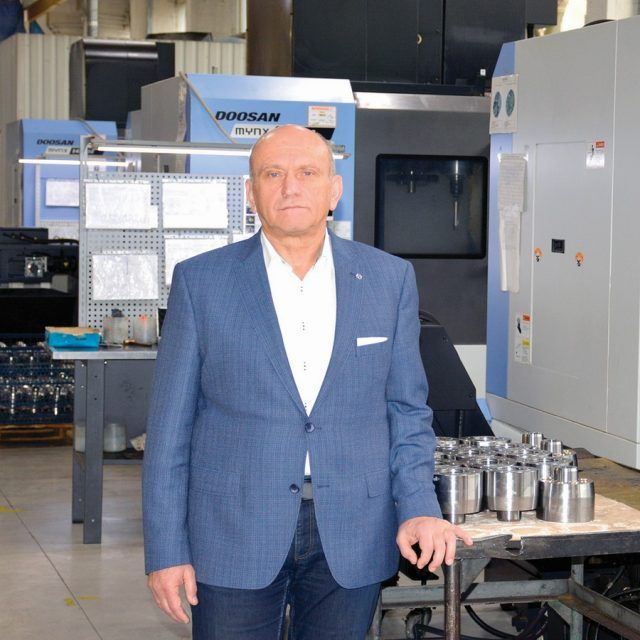
Alexander Shamshur, Director of HYDROSILA APM, offers a comparison: if a gear pump is a destroyer, an axial piston pump is an aircraft carrier.
Nowadays, it sometimes seems that almost everything around us comes from China — from everyday clothing to smartphones. Yet there are enterprises in the Kirovohrad region that export their products to China rather than simply importing Chinese goods. HYDROSILA APM is one of them.
China has become famous for reproducing products developed elsewhere. There is even a joke that while children here make wooden stools in practical training classes, Chinese children make iPhones. Yet China has been buying hydraulic units manufactured in Kropyvnytskyi for many years.
One might assume that Chinese manufacturers could have copied these products and launched their own production long ago. But producing a high-quality hydraulic unit is not simply a matter of copying its design. The manufacturing technology, precision and accumulated expertise are far more difficult to reproduce.
Moreover, HYDROSILA APM remains competitive in terms of price and quality. Despite China's extensive industrial capabilities, producing hydraulic equipment of comparable quality at a competitive price is not always straightforward.
Alexander Shamshur, who has visited China many times, recalls one particularly striking experience:
“When I first flew to Shanghai, the air was almost impossible to breathe, and the streets were packed with mopeds and motorcycles. I returned just three months later and could hardly find a single moped with an internal combustion engine. The authorities had banned them, and everyone was riding electric bicycles instead. Strangely enough, the air did not seem much cleaner. But that is another story.”
China is a highly progressive and rapidly developing country, and Ukrainian manufacturers have found opportunities in its market.
According to Alexander Shamshur, the Chinese approach to operating machinery is very different. Equipment downtime is barely tolerated. Concrete mixer trucks work around the clock, with drivers changing shifts, because major construction projects operate continuously.
If a concrete mixer truck breaks down, it may simply be taken out of service and replaced by another vehicle equipped with HYDROSILA hydraulic units.
The author of this article worked at HYDROSILA during the Soviet era. Nearly thirty years later, I returned to the workshops that had once been so familiar to me.
Of course, we live in a period of rapid technological change. When I worked at the factory, I had never even heard terms such as “the Internet” or “mobile phone.” But the improvements I saw during this visit were remarkable.
In those days, some machines at the plant had been brought from Germany after the Second World War. Today, HYDROSILA APM also operates German machines, but these are modern precision machining centers manufactured by HÜLLER HILLE, one of the world's leading machine-tool manufacturers.
The plant also uses American, Japanese, Austrian and Swiss equipment, along with numerous DOOSAN machines from South Korea.
Ukrainian equipment is represented as well, including machines manufactured by the Lubny Machine Tool Plant and equipment developed through a joint project between HYDROSILA APM and Motor Sich in Zaporizhzhia, a manufacturer of aircraft and helicopter engines.
Over the past decade, investors have allocated UAH 278 million to the plant, its equipment and the computerization of production.
There is something about powerful industrial machinery that many people have admired since childhood: its strength, energy and imposing appearance. Yet there is another kind of beauty in watching a sophisticated machining center transform a rough steel workpiece into a precision-engineered component.
For those familiar with machining, modern machining centers are particularly fascinating. Each has an automatic tool magazine containing dozens of drills, milling cutters and other tools.
I remembered how frequently cutting tools had to be changed manually on the old Krasny Proletary lathe. Today, much of this process is automated.
That is the twenty-first century.
Alexander Shamshur, Director of HYDROSILA APM, is understandably proud of the enterprise he manages.
— What kinds of familiar machines use the hydraulic units manufactured at your plant?
— Our products are used in BELAZ mining dump trucks from Belarus and in various types of MAZ equipment, including buses operating in Ukraine.
If you see a concrete mixer truck in our city, there is a good chance that its drum is driven by one of our hydraulic units.
Overall, we currently supply products to approximately fifty countries. China and Southeast Asia are major markets, with Thailand being particularly important. We also supply the United States, Turkey and European countries.
Vietnam is one of the latest markets we have entered, and there is demand for our products there as well.
— Could you tell us more about your business in the United States?
— Our hydraulic units are purchased by companies in the oil production and refining industries. We also supply a substantial quantity of spare parts, primarily rotating assemblies.
— Yet at one time, your company wanted to purchase the technology for manufacturing these products from the Americans!
— That is true. In 1977, there was a strong demand for such hydraulic units in the Soviet Union, and the original plan was to obtain an American manufacturing license.
However, the Americans considered this technology to have potential military applications and therefore regarded it as dual-use technology. Indeed, hydraulic drives are also used in tanks.
Eventually, an agreement was reached with the German company Sauer-Sundstrand. We purchased a license and manufacturing equipment and began preparing for production.
The plant underwent major reconstruction, and the first experimental hydrostatic transmission was assembled in November 1979.
Equipment worth USD 19 million was purchased. But perhaps the most remarkable achievement was the speed of implementation: the entire project, from the initial concept to the launch of production, took just two and a half years.
At that time, such a pace was almost unimaginable.
Many of the technologies we obtained from the Germans remain relevant and effective today.
For example, we originally planned to introduce a process for removing burrs from internal passages in pump housings using a controlled combustion process. We even purchased equipment from Bosch, but implementation was prevented by safety requirements and other difficulties.
Last year, we finally acquired the necessary equipment and introduced this technology.
It is known as thermal deburring. A combustible gas mixture is ignited inside a sealed chamber, producing a rapid thermal reaction that removes burrs and sharp edges from internal passages.
As far as I know, we are the only enterprise in Ukraine using this technology.
But none of these achievements would have been possible without the people who worked here.
One of the key figures was Viktor Nikolayevich Zhovtobryukh. He was the driving force behind the project.
I joined the plant in 1978, just as the axial piston machinery project was getting underway.
Not all the licensed technical documentation had arrived at that point, but Viktor Nikolayevich had already developed much of the manufacturing process himself.
When the documentation finally arrived, we compared it with his work and found very few differences.
There were many other talented specialists: Grigoryev, Vorona, Petrovsky, Tkachenko and others.
I would say that about 80% of the ideas we still use today originated from their work.
At that time, the term “project management” was not widely used, but that is exactly what we were doing.
We had to coordinate product design, construction of production facilities, equipment deliveries and the supply of materials.
Sometimes we could not obtain the required bronze or a particular grade of steel. But solutions were found.
Working together with metallurgical plants, we developed suitable materials and manufacturing processes, many of which are still used today.
The introduction of axial piston machine production was a technological breakthrough for the entire enterprise.
We received equipment and technologies of a level we had never encountered before, along with new tools and Japanese coordinate measuring machines.
German, American and Swiss specialists worked with us.
They introduced European manufacturing practices and established exceptionally high standards.
Of course, there were difficulties.
For example, a valve block was manufactured for us at a plant in Pargolovo, near Leningrad, using the same licensed technology.
After the collapse of the Soviet Union, we travelled there and manually documented the manufacturing process. We then returned to our plant and established production ourselves.
And this was in the early 1990s. You can imagine how difficult it was to accomplish anything at that time.
I believe HYDROSILA has always been fortunate with its directors.
First there was Viktor Nikolayevich Zhovtobryukh, followed by Gary Vasilyevich Bugreev.
They preserved the workforce and the enterprise's industrial capabilities. They did not allow valuable equipment to be sold off as scrap.
Then Pavel Stutman and Yuri Titov arrived, and a new technological transformation began.
We are now moving toward Industry 4.0.
You are probably familiar with the concept.
Industry 1.0 marked the transition from manual labor to mechanized production powered by steam and water.
Industry 2.0 introduced electricity, assembly lines and mass production.
Industry 3.0 brought computer numerical control, automation and the first industrial robots.
Industry 4.0 represents the digital integration of manufacturing processes, equipment and information systems.
The world is moving toward increasingly connected production systems, with closer interaction between people, machines and digital technologies.
Already today, I can sit in my office and use a computer to see how a particular machine is operating, how many parts it has processed during the day, whether it has experienced downtime and what caused it.
Not all machines are connected to the network yet, but we are steadily introducing an intelligent production monitoring and control system in cooperation with an engineering company from Dnipro.
We also operate a modern ERP production management system.
It was introduced in April 2002. It is an American system that was initially implemented at Boeing.
For the development of new products, we use modern SOLIDWORKS engineering software.
Ten years ago, our design department employed around one hundred people. Today, there are fifteen.
Modern technology has made this possible.
Engineers no longer need to spend hours searching through reference books in a library. Much of the routine work that previously occupied designers and engineers has been automated.
Incidentally, most of our designers are young specialists, many of whom have been with us for four to six years.
In 2009, we manufactured seven product models.
Today, we manufacture 39 models.
That gives you an idea of how much the enterprise has developed in ten years.
The changes have been dramatic.
Initially, we manufactured only swashplate-type axial piston pumps, which had a relatively limited range of applications.
In 2010, we launched a project to develop bent-axis axial piston pumps.
By early 2012, we had introduced three versions of these pumps.
There was already a market for them, and customers were waiting.
We purchased a unique Swiss machine tool — one of only a few of its kind in the world.
Unlike our earlier products, which had been manufactured under license, these new pumps were developed through our own engineering project.
That meant extensive design work, prototype manufacturing, testing and solving countless technical problems.
It was the result of the efforts of many people.
Last year, we manufactured 30,000 hydraulic units, along with a substantial quantity of spare parts.
Since the establishment of the enterprise in 2009, we have produced 301,500 units.
That means hundreds of thousands of machines of various types around the world are operating with hydraulic components manufactured here.
We work in three shifts.
As for production equipment, over the past three years we have purchased 22 new machine tools and decommissioned 106 older machines.
Despite the reduction in the number of machines, our manufacturing efficiency has increased.
Modern equipment from leading manufacturers can be five times more productive than older machines, even those originally manufactured abroad.
For example, one HÜLLER HILLE horizontal machining center replaced fifteen conventional machine tools.
And that is without even considering the improvement in machining quality.
Today's market presents new challenges. Everything must be developed and introduced much faster if a manufacturer wants to remain competitive.
We recently developed and launched production of hydraulic units for Belarusian truck cranes in record time.
By the way, we also supply hydraulic equipment for mining loaders in China.
- It is even surprising that your products are not forged in China.
- The situation is specific there. Our competitors, the world's largest Danfoss manufacturers, Eaton have built their own hydraulic plants in China. But we have a more competitive price with high quality. And China's market is the largest in the world. So they buy our products there.
- The next ten years of successful work for you!
Источник: http://uc.kr.ua/2019/11/19/gydrosyla-apm-zavod-xxi-veka